Jefferson Long
Books
© 2026 Jefferson Long. All rights reserved.
Published by J. Lara Publishing.

recent release
Going South: A Tragedy of Love and Self-DeceptionSample Chapter:
Natalja
Trigger Warning:
This chapter contains disturbing themes, including suicide, death, decomposition, and graphic sensory descriptions. It also touches on childhood trauma, psychological distress, and memory fragmentation. Reader discretion is advised.
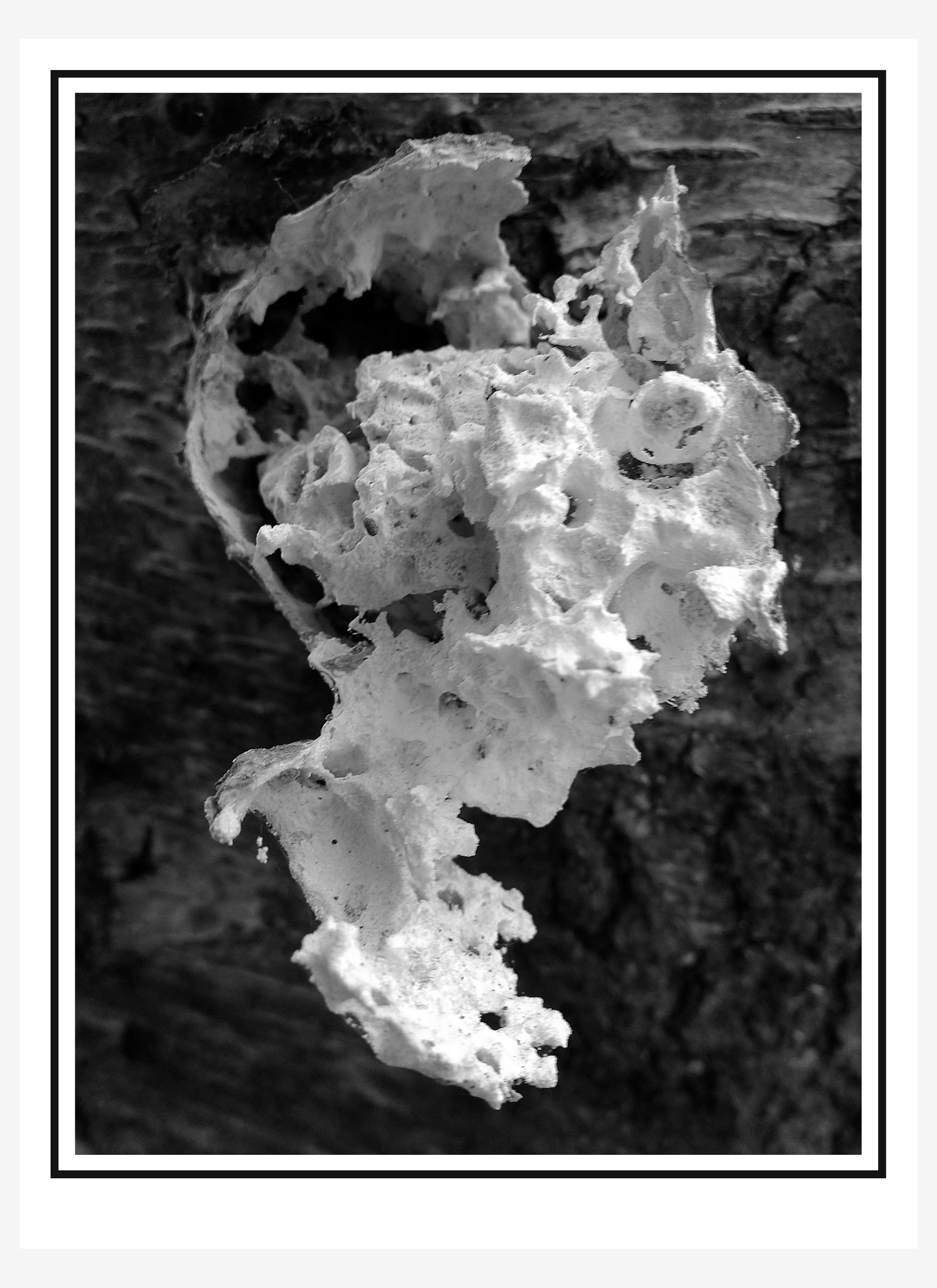
J. Long Going South: A Tragedy of Love and Self-Deception
Natalja
We eat together at your small kitchen table, and it feels like a new life to me—new, yet somehow already familiar.
.
After dinner, we sit on your bed with tea, watching a YouTube animal documentary. Your mood suddenly darkens. Do I know that too—when a sudden drop hits, everything feels hopeless, like you’re trapped in an endless loop? Yes, I know it all too well. You want to know everything about me—my marriage, my daughter, my first marriage.
.
I talk openly about it all, for the first time in years. The clinic stays, the total overwhelm of managing daily life. My months-long illness. Lying in bed later, I read you my short story:
.
◆ ◆ ◆
.
Natalja
.
.
“But it’s just fog,” she said, laughing,
“nothing but harmless fog!”
.
.
Monday, November 30, 2015
.
I try to sleep, but it eludes me. Two cups of coffee—the first in years—breakfast with you, then back home. Eventually, I drift off, finding myself in a forest. Shapes blur, trees turn into walls, leaves into a ceiling. Now I stand in a hall made of forest. When I open my eyes, darkness falls. A lost day. The smell of food lingers. Dogs bark. I remember.
.
The Eifel, long walks through the mountains, a place too beautiful to be real. The narrow path through the spruces, too tight to walk side by side. Then the clearing, the Celtic stone grave with the oaks. A round wall of trees, and between them, the blue sky. I am grateful and happy. Later, I’ll bring her here; we’ll make love, it’ll be her first time and the last time I see this place like this, because then the forest workers come, cutting swathes, leaving trunks scattered, desecrating, destroying.
.
.
Tuesday, December 1, 2015
.
Today, everything is fine—no dreams, at least none I can recall. I think of you. I try to picture your face, but I can’t. It doesn’t matter.
.
.
Wednesday, December 2, 2015
.
The problem with reality is that you only ever see it through your own mind. How do I know you’re more real than any dream? I perceive everything through the vitreous of my eyes and the tubes of my ears. In the end, it’s all electricity.
If you send a current through the right wires, every sensation can be artificially produced. With a battery and the right nerves, you can generate reality. Surreal, yet logical. By that logic, it’s also possible to alter reality with sheer willpower. The divine within us is nothing more than simple electricity.
What remains when we die? An empty battery, slowly decomposing.
.
.
September 1985
.
I’m thirteen years old. Before me lies a perfectly round crater, about seven meters across, filled with water and the rotting leaves of the past forty years. Low shrubs and century-old trees surround me. A rope, stretched as taut as we could manage together. One by one, we cross the bomb crater, lying on the rope, one leg dangling—my brother, the little Japanese boy, and me. The little Japanese boy is clumsy. He lands in the water, the decaying leaves up to his waist. It’s warm for the season, early September.
Hours pass. We plan a hut, then abandon the idea, search for spears, and throw them in a contest. Beyond the bomb crater, one of the canals connects the preheater to the outdoor pool. Long ago, the water here was naturally warmed before being piped into the pool. I imagine men in striped swimsuits taking a front-line leave, spending a few carefree hours here before the fog and the noise call them back.
.
.
December 1985
.
It’s cold. The little Japanese boy has to go to piano lessons. I’m with my brother at the bomb crater. We try to fish the leaves out of the water. A foul smell. We blame the leaves—wrongly. Hours pass. We run through the forest, play tag, hide. Hunger drives us home. We decide to build a treehouse, soon.
.
.
Sunday, December 6, 1985, 8:25
.
A schedule hangs on the fridge, pinned with a small round magnet. It’s my turn to serve. Our curate is holding the Mass. I don’t like him, and he doesn’t like me. For him, there are the altar boys who let themselves be touched and the others, whom he bullies and slaps. I didn’t want to be in the first group.
It’s cold and foggy. I leave the house at half past eight, walk down the street to the end, but instead of crossing the wide road, I follow it toward the Volksgarten. I have an hour to kill, and I’m determined to spend it at our bomb crater.
.
.
1996, Summer
.
I love her scent. She doesn’t shave, and it looks beautiful on her. I only know her this way and wouldn’t want it otherwise. Sometimes my nose is a curse, but I savor it when she’s hot for me. Every woman has something unforgettable, something unique, something that drives you mad when she’s not there and wild when she is. With Natalja, it was her scent.
.
.
Sunday, December 6, 1985, 8:50
.
Not a car on the road. Everything looks like a dream. The street fades into white nothingness on both sides. The little footpath comes up quickly. I turn right off the path, push low-hanging branches from my face, and leap over the first canal. Now I’ve arrived in a magical land. I’m happy and start to run. The fog is impenetrable in places. Cold and warm air alternate. Between the trenches, startled rabbits dart in zigzags. I warm up and take off my anorak.
Two meters ahead, he appears out of nowhere. It dawns on me slowly; I don’t understand where he was yesterday. We spent hours here—happy, carefree hours. Though, the smell—now it makes sense. I didn’t realize rabbits would eat something like that, cannibalistic rabbits, gnawed bones beneath a rotting coat. I think I see a mannequin, one of those with a long, stylized head and a slender neck. Then I spot an ear. The coat has a hole, ribs behind it, indistinguishable from the branches in color.
Pan, half man, half plant—suddenly the meaning clicks. Around his neck, the rope, wound over and over. Kneeling, he’s taller than I am standing. How did he manage it? Gravity against the will to survive, the lack of oxygen—he could’ve just stood up again. Or did someone help him? I’ll carry this image inside me, encapsulated like the shard of a fracture, deep within. Sometimes it’ll rise to the surface, yes, sometimes, when I’m feeling low. A plastic bag with neckties—why is that lying here?
.
.
From the local section of the newspaper, December 10, 1985:
.
"Boy Finds Body in Woods"
On Sunday, a thirteen-year-old boy discovered a body while playing in a wooded area near the outdoor pool. The man had been missing for eight weeks and was until then a resident of the nearby nursing home.
.
.
1996, Autumn
.
Natalja is gone. She came from afar and returned there, but she took something of me with her, deep inside her. She’d told me about it; I didn’t want to believe it. I’ll never forget her. Sometimes I think I catch her scent. But it fades; the synapses in my brain rewire themselves, erasing her. What we call memory is an echo of an echo of synapses once linked in our cerebral cortex. A backup of a backup—nothing is real anymore.
The policeman on his motorcycle didn’t believe me; he sent me away to vomit. Even ten years later, I see the echo of an echo of that ear in the fog. I never knew his name—Pan, on his journey into nothingness.
.
Natalja, where are you? Why are your parents gone—did they take you with them? I find no trace of you. You looked so happy when we were together—why did you leave?
Another dream: the clearing in the Eifel, Pan hanging from a tree, twilight of the gods. Fog rolls in, Natalja’s face flickering through it—disbelieving, questioning, then panicking. I wake up, feeling like I’m suffocating.
.
.
Friday, December 4, 2015
.
After all this time, sometimes it’s just a spark, a blurry image, a fleeting moment, ungraspable. I often wonder if I saw the image or just remembered that an image once existed. I can’t recall her scent anymore, but sometimes I catch the smell of rotting leaves on that St. Nicholas morning in the fog. In my dream, I float through the forest, see the rabbits darting through the mist. I know where this is heading; I jolt awake, usually in time, but today it presses on relentlessly—an echo of an echo of memory, so real all of a sudden. Where have you been all these years?
.
I live in a different place now, in a different time. I have a wife, children. But the dreams stay, coming and going. In them, I drift to the bomb crater, smell the foul leaves, but Pan is gone. The undertakers left the rope hanging; the bag with the ties disappeared eventually. I sink into the ground, feet first, but in the dream, I have no feet—just consciousness, bodiless, like everything else here.
And then another dream. I stand at the edge of the little lake with its foul smell, clouding my senses. I’m sweaty, my shoes caked with dirt. In my hand, a spade. A quick kick, and the metal shovel breaks off. I toss it and watch it sink. Bubbles form and linger on the surface far longer than they should. Panic rises in me. I bury the handle in the soft earth.
.
.
Sunday, December 6, 2015, St. Nicholas Day
.
It’s autumn again, fog again. I leap over the ditch—not as nimble as I once was—but with the jump comes the memory of the moment everything changed. The little tree—I don’t find it at first—but then I stand before the water-filled hole. The thought of back then hurts; there’s no changing it now. I need certainty: How real is reality? Or are my dreams, in the end, more real than reality itself? In the trunk of my car, the shovel rattled with every turn. Now I dig into the soft soil. I wonder what’s left of that other shovel when I uncover the first bones.
.
And immediately, I can remember her scent again.
.
◆ ◆ ◆
.
After I stop reading, you cling to me as if you want to crawl inside me. Your eyes are closed, but I can see tears on your face. Long after you’ve fallen into a deep sleep, I gently disentangle myself from your embrace and turn off the small floor lamp beside us.
The next morning, you’re distant, very distant. Later that day, you’re invited to a birthday party. Once again, no thought of taking me along. I register it and try not to feel anything about it.
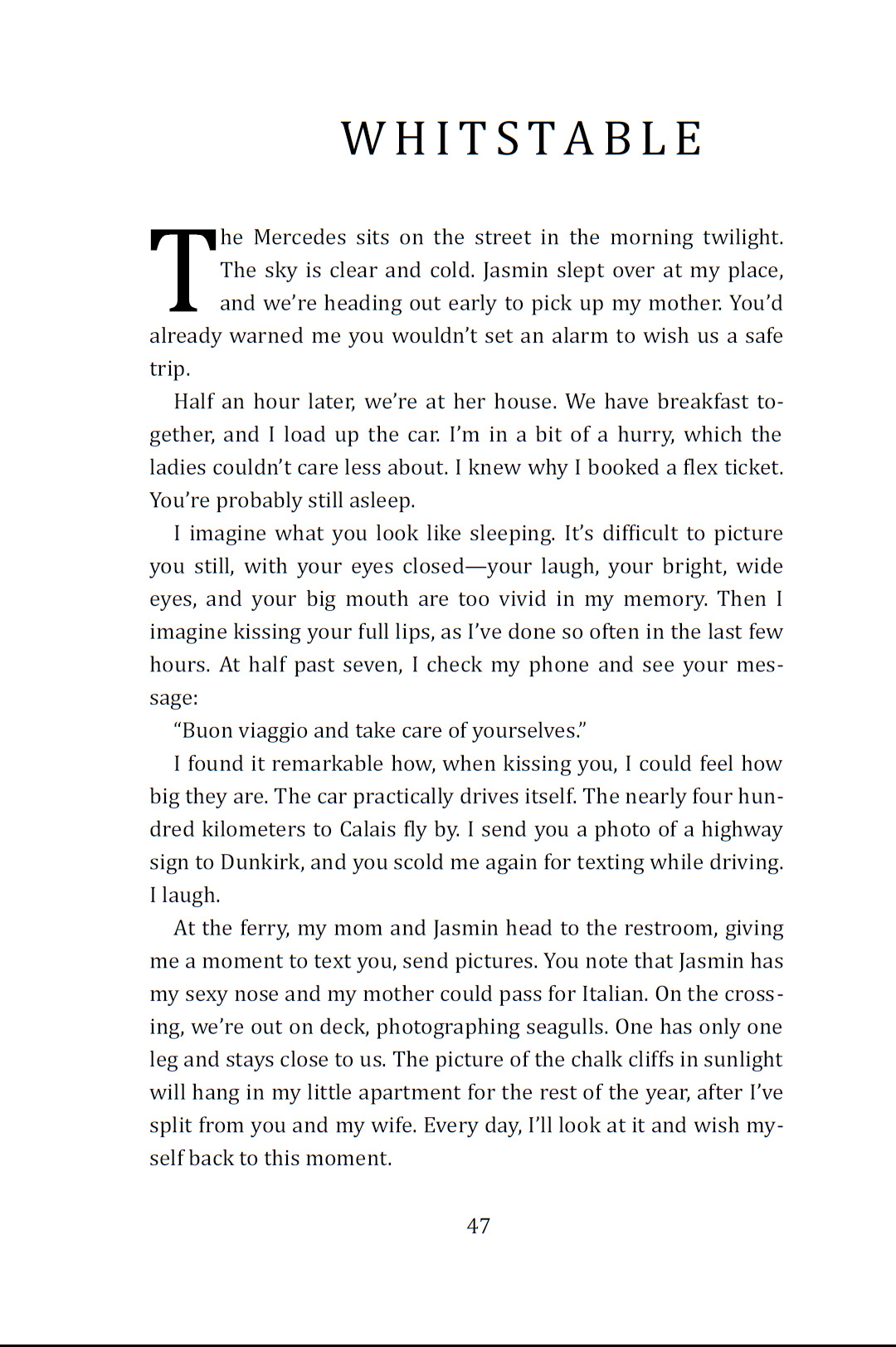
Page Layout — Going SouthTrim Size
6 × 9 in (152.4 × 228.6 mm)Margins
Inner: 1.0 in
Outer: 0.75 in
Top: 0.65 in
Bottom: 0.75 inBody Text
Typeface: Cambria
Size: 11 pt
Leading: 13.5 ptChapter Heading
Typeface: Cambria
Size: 24 pt
Style: All caps
Kerning: Manually adjustedDrop Cap
Typeface: Cambria
Depth: 3 lines
Scaling: Optically adjusted per glyph
Position: Slight hang into margin; baseline aligned to first line of body text
Tracking/kerning: Manually
About
Jefferson Long is a writer and photographer working with 35mm and medium format film. His photographic practice focuses on architecture and natural landscapes, approached with a precise attention to detail and a willingness to experiment with form and process. Working with vintage film cameras, he develops his images by hand using Caffenol, a mixture of coffee, washing soda, and vitamin C.Born in Germany, Long studied English Literature and Media, and worked with artists including Sabine Kacunko and Joachim Storch. His work across both disciplines is guided by a shared interest in perception, structure, and the subtle relationships between space, time, and human experience.
Imprint:
© 2026 Jefferson Long. All rights reserved.
Published by J. Lara Publishing.All text and photography are original works by Jefferson Long and were created without the use of artificial intelligence.Jefferson Long is a founding member of AAA (Artists Against AI-created content).